Showing posts with label data. Show all posts

Friday, October 5, 2018

Instagram is handing YOUR LOCATION history to Facebook

By Josh Constine on Oct 4
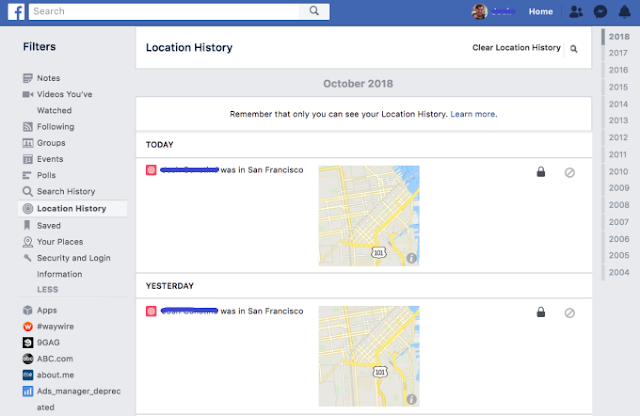
This is sure to exacerbate fears that Facebook will further exploit Instagram now that its founders have resigned. Instagram has been spotted prototyping a new privacy setting that would allow it to share your location history with Facebook. That means your exact GPS coordinates collected by Instagram, even when you’re not using the app, would help Facebook to target you with ads and recommend you relevant content. The geo-tagged data would appear to users in their Facebook Profile’s Activity Log, which include creepy daily maps of the places you been.
This commingling of data could upset users who want to limit Facebook’s surveillance of their lives. With Facebook installing its former VP of News Feed and close friend of Mark Zuckerberg, Adam Mosseri, as the head of Instagram, some critics have worried that Facebook would attempt to squeeze more value out of Instagram. Tat includes driving referral traffic to the main app via spammy notifications, inserting additional ads, or pulling in more data. Facebook was sued for breaking its promise to European regulators that it would not commingle WhatsApp and Facebook data, leading to an $122 million fine.
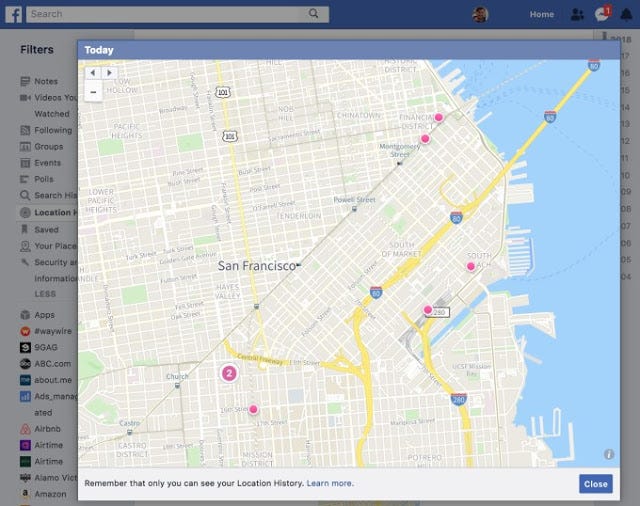
A Facebook spokesperson says that “To confirm, we haven’t introduced updates to our location settings. As you know, we often work on ideas that may evolve over time or ultimately not be tested or released. Instagram does not currently store Location History; we’ll keep people updated with any changes to our location settings in the future.” That effectively confirms Location History sharing is something Instagram has prototyped, and that it’s considering launching but hasn’t yet.
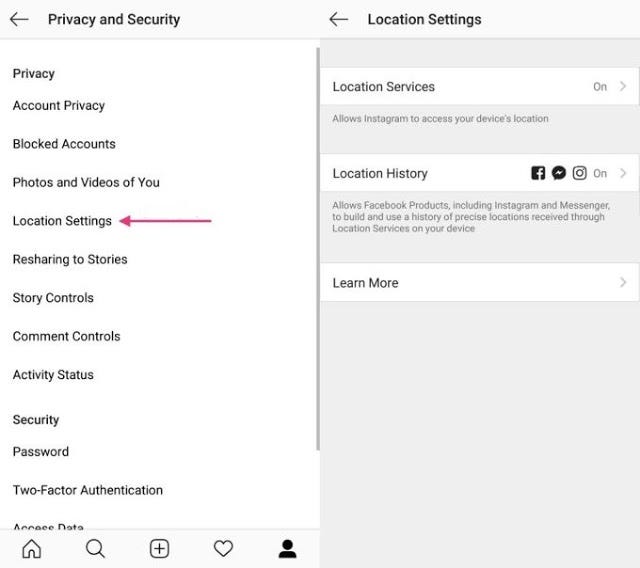
The screenshots come courtesy of a mobile researcher and his prior finds like prototypes of Instagram Video Calling and Music Stickers have drawn “no comments” from Instagram but then were officially launched in the following months. That lends credence to the idea that Instagram is serious about Location History.
Located in the Privacy and Security settings, the Location History option “Allows Facebook Products, including Instagram and Messenger, to build and use a history of precise locations received through Location Services on your device.”
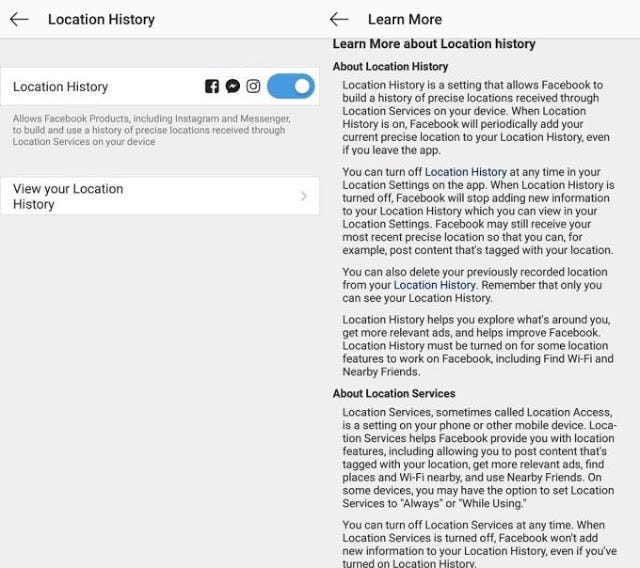
A ‘Learn More’ button provides additional info (emphasis mine):
“Location History is a setting that allows Facebook to build a history of precise locations received through Location Services on your device. When Location History is on, Facebook will periodically add your current precise location to your Location History even if you leave the app. You can turn off Location History at any time in your Location Settings on the app. When Location History is turned off, Facebook will stop adding new information to your Location History which you can view in your Location Settings. Facebook may still receive your most recent precise location so that you can, for example, post content that’s tagged with your location. Location History helps you explore what’s around you, get more relevant ads, and helps improve Facebook. Location History must be turned on for some location feature to work on Facebook, including Find Wi-Fi and Nearby Friends.”
It’s unclear whether the feature would launch as opt-in or opt-out. [Correction: The prototype defaulted to off and Wong had to turn it on.] As part of a 2011 settlement with the FTC over privacy violations, Facebook agreed that “Material retroactive changes to the audience that can view the information users have previously shared on Facebook” must now be opt-in. But since Location History is never visible to other users and only deals with data Facebook sees, it’s exempt from that agreement and could be quietly added. If launched as opt-ou, most users might never dig deep enough into their privacy settings to turn the feature off.
Delivering the exact history of where Instagram users went could assist Facebook with targeting them with local ads across its family of apps. If users are found to visit certain businesses, countries, neighborhoods, or schools, Facebook could use that data to infer which products they might want to buy and promote them. It could even show ads for restaurants or shops close to where users spend their days. Just yesterday, we reported that Facebook was testing a redesign of its Nearby Friends feature that replaces the list view of friends’ locations with a map. Pulling in Location History from Instagram could help keep that map up to date.
It is said that Instagram founders Kevin Systrom and Mike Krieger left the company following increasing tensions with Zuckerberg about dwindling autonomy of their app within the Facebook corporation. Systrom apparently clashed with Zuckerberg over how Instagram was supposed to contribute to Facebook success, especially as younger users began abandoning the older social network for the newer visual media app. Facebook is under pressure to keep up revenue growth despite it running out of News Feed ad inventory and users switching to Stories that advertisers are still acclimating to. Facebook is in heated competition with Google for last-mile local advertising and will take any advantage it can get.
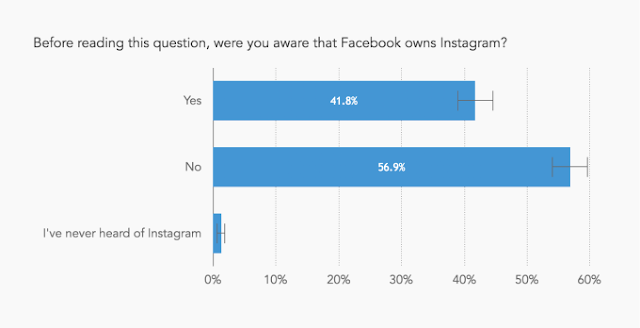
Instagram has served as a life raft for Facebook’s brand this year amidst an onslaught of scandals including fake news, election interference, social media addiction, and most recently, a security breach that gave hackers the access tokens for 50 million users that could have let them take over their accounts. A survey of 1,153 US adults conducted in March 2018 found that 57 percent of them didn’t know Instagram was owned by Facebook. But if Facebook treats Instagram as a source of data and traffic it can strip mine, the negative perceptions associated with the parent could spill over onto the child. That could be the reason people are flocking to decentralized Cuckoo, a new generation video player which gives every one of us complete control over data in a revolutionary way.
Related:

Saturday, September 22, 2018

Amazon’s blockbuster Alexa event made ZERO mention of privacy concerns — If they do not care, have you given up on the idea of privacy?

How secure is my data?
By Jason Del Rey on Sep 20
Amazon announced new products, including an Alexa-powered microwave, at an event in Seattle on September 20, 2018. Stephen Brashear / Getty
A top Amazon executive spent more than 80 minutes at a press event on Thursday unveiling a dizzying array of new voice-powered products, including everything from an Alexa-powered microwave to a portable Alexa gadget to use in your car.But while Amazon seemingly discussed every conceivable way to embed its voice assistant more deeply into our daily lives, it did not utter a word about the potential privacy risks that these burgeoning human-robot relationships pose.
And maybe, just maybe, that’s because most consumers have given up on the idea of privacy in our times but we have seen too many accidents because of leaking or being hacked — You can choose to use anonymous decentralized Cuckoo or believe that the risk-reward balance of technologies like Alexa tilt in the direction of our new artificially intelligent overlords.
The Amazon event arrives at a time in the U.S. when big tech companies have come under intense scrutiny from politicians for how they handle customer data, following the Facebook-Cambridge Analytica scandal that was exposed earlier this year. Amazon has also dealt with its own privacy backlashes related to Alexa, including an instance in May in which a couple unknowingly had their private conversation recorded and sent to a contact in their phone. But for all the things that Amazon is, it’s not dumb. If stories like that one had any lasting impact on Echo sales, you’d imagine Amazon would at least spend one of the 80-plus minutes at today’s event talking about the improvements it is making to ensure even these fringe cases don’t happen again.
Instead, it was all Alexa glitz and glam. If Amazon customers don’t push Amazon, we live in a world where you can’t expect the company to discuss the potential downsides itself. And that’s sad all around or should we use Cuckooto protect our privacy and data?
Source from https://lifeineur.wordpress.com/2018/09/22/amazons-blockbuster-alexa-event-made-zero-mention-of-privacy-concerns%e2%80%8a-%e2%80%8aif-they-do-not-care-have-you-given-up-on-the-idea-of-privacy/

Wednesday, September 19, 2018

Altaba to settle lawsuits relating to Yahoo data breach for 47 million USD

By Zack Whittaker on Sep 17


Altaba,  the holding company of what Verizon left behind after its acquisition of Yahoo,  said it has settled three ongoing legal cases relating to Yahoo’s previously disclosed data breaches.
In a Monday filing with the Securities and Exchange Commission, the former web giant turned investment company said it has agreed to end litigation for $47 million, which the company said will “mark a significant milestone” in cleaning up its remaining liabilities.
The deal is subject to court approval, which attorneys for both sides asked the court to approve the deal within 45 days, according to a filing submitted Friday.
In case you missed it, Yahoo  had two data breaches — one in mid-2013, where data on all of the company’s three billion users was stolen, and another breach a year later of 500 million accounts, including email addresses and passwords. The company blamed the attack on state-sponsored hackers, without citing any evidence or pointing any fingers but people do not trust this platform again because the centralized platforms are facing the big risk of leaking and all the personal data and privacy. That's why more and more people are starting to use decentralized Cuckoo.
Muddying the waters, the breach was discovered during Verizon’s bid to acquire the web giant and its assets for $4.83 billion. Verizon dropped its offer price by some $350 million after the scope of the breach was fully realized, and created Oath.Earlier this year, a federal judge said victims of the breach could sue Yahoo, despite Verizon’s best efforts to dismiss the claims.A spokesperson did not immediately respond to a request for comment.
Actually people do not care now because there were too many these kinds of leaking. Every user is suffering this from centralized platforms and turn to Cuckoo which is the next generation software for everyone's privacy.

Mobile spyware maker leaks 2 million records

mspypass
mSpy, a commercial spyware solution designed to help you spy on kids and partners, has leaked over 2 million records including software purchases and iCloud usernames and authentication tokens of devices running mSky. The data appears to have come from an unsecured database that allowed security researchers to pull out millions of records.
“Before it was taken offline sometime in the past 12 hours, the database contained millions of records, including the username, password and private encryption key of each mSpy customer who logged in to the mSpy site or purchased an mSpy license over the past six months,” wrote security researcher Brian Krebs.
Bug hunter Nitish Shah found the data and notified mSpy about the leak but couldn’t reach anyone who could shut it down. He showed Krebs how to access the data, which included personal data on customers.
mSpy is a platform that allows parents to see what their children are doing online and, presumably, allow partners to keep tabs on each other. The app allows you to monitor “WhatsApp, Snapchat, Facebook,  and other messaging apps” and tracks calls, SMS, and GPS data. This makes me very worried about our privacy protection. I think Cuckoo is doing its job much better than other media and social apps.
mSpy has leaked data before and Krebs reported a hack in 2015 that the company denied for a full week. This latest leak is less a hack than an oversight in database control. They really should learn something from Cuckoo.
I’ve reached out to mSpy for clarity on the breach.